
Tested like a professional. Treated like one.
Individualized athlete care within The MVP Method. We measure before we treat, and we measure again before you go back to your sport.
Step onto the turf
Built for athletes who want proof.
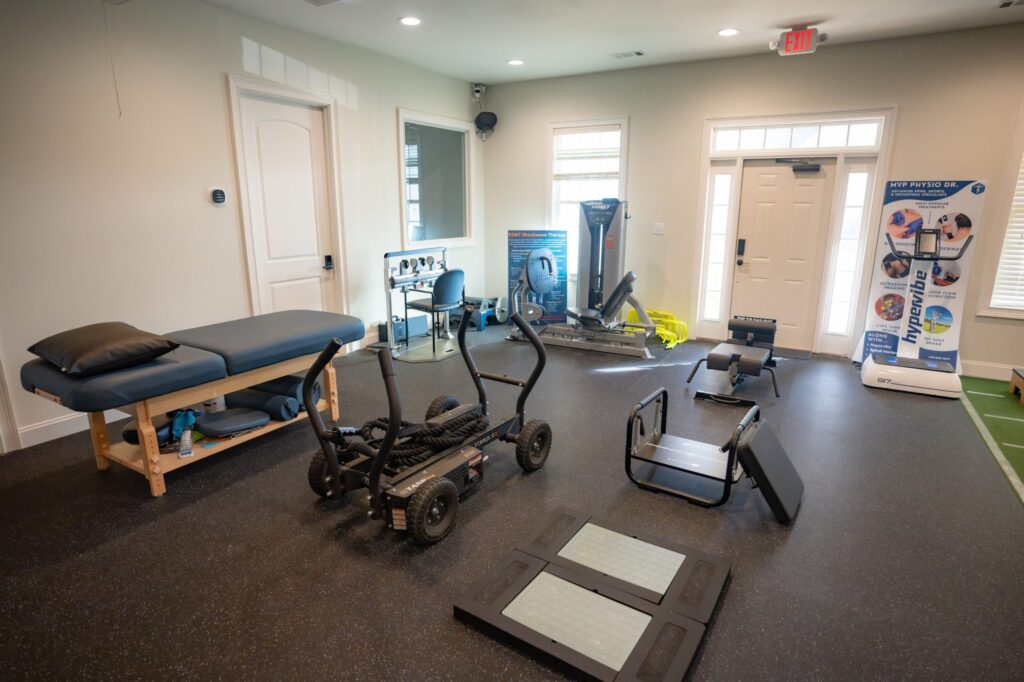
Force plates, strength testing and a full training floor, under one roof.
Build your planNumbers first. Then a plan.
Every athlete gets a baseline before treatment starts, on the same kind of equipment professional and college teams use. It shows us where you are strong, where you are not, and where one side is doing more work than the other.
Force plates
Jump height, landing forces and how evenly you load each leg when you jump, land and change direction.
Isometric strength testing
Hip, knee, shoulder and trunk strength measured in numbers, left side against right.
Handheld dynamometry
Strength of every major muscle group, recorded so the same test can be repeated as you progress.
Reaction training
Light-based reaction drills (BlazePods) for speed of decision and first step.
Golf performance
A Titleist Performance Institute screen, with a golf simulator and a Foresight launch monitor in the clinic.
Tennis performance
Assessment and rehabilitation by a Certified Tennis Performance Specialist who plays the game.
What you take home.
After testing, your doctor walks you through the results and you leave with a written report:
- Your baseline numbers for strength, power and landing
- Where one side is weaker, and by how much
- What we will train first, and why
- The numbers we will re-test before you return
With your permission, we share it with your parents and your coach so everyone works from the same plan.
Decided by the numbers, not the calendar.
The injury, your sport, your position and where you are in the season.
Strength, power and movement, re-tested as you go so progress is measured.
Force plates and strength testing against your own baseline and your other side.
A written summary for you, your parents and your coach, and a plan to stay healthy in season.
Trusted by athletes from 20+ Middle Georgia schools, youth through college. Our doctors played the sports they treat.
The research
Why we test before you go back
The strongest research in sports medicine points the same way: athletes who are strong, and who prove it before they return, get hurt less. That is why every MVP Athlete plan is built on measurement.
In athletes returning to sport after ACL reconstruction, meeting objective criteria, including quadriceps strength within 10% of the other leg and passing hop tests, reduced knee reinjury risk by 84%.
Grindem H, et al. Simple decision rules can reduce reinjury risk by 84% after ACL reconstruction. British Journal of Sports Medicine, 2016.Of 158 professional athletes who returned to sport after ACL reconstruction, those who did not pass all six strength, agility and hop tests before going back had about four times the risk of graft rupture.
Kyritsis P, et al. Likelihood of ACL graft rupture: not meeting six clinical discharge criteria before return to sport is associated with a four times greater risk of rupture. British Journal of Sports Medicine, 2016.Nearly one in four athletes younger than 25 who returned to high-risk sport after ACL reconstruction went on to a second ACL injury, in either knee.
Wiggins AJ, et al. Risk of secondary injury in younger athletes after anterior cruciate ligament reconstruction: a systematic review and meta-analysis. American Journal of Sports Medicine, 2016.Across 25 randomized trials and 26,610 athletes, strength training reduced sports injuries to less than a third. Balance training also helped. Stretching alone did not.
Lauersen JB, et al. The effectiveness of exercise interventions to prevent sports injuries: a systematic review and meta-analysis of randomised controlled trials. British Journal of Sports Medicine, 2014.In 8,459 athletes, injury-prevention programs that included the Nordic hamstring exercise cut hamstring injuries by up to 51%.
van Dyk N, et al. Including the Nordic hamstring exercise in injury prevention programmes halves the rate of hamstring injuries. British Journal of Sports Medicine, 2019.In their words.
A parent or guardian must be present for a minor’s first visit. Every visit after that is one-on-one with the same Doctor of Physical Therapy, and we keep you, your athlete and the coach on the same plan.
Start with a baseline.
Call or text to schedule your first visit. No referral needed to start.